
Have you ever wondered why some websites show up at the top of Google while others are buried on page 10? The answer is search engine positioning. In this guide, we will explain everything you need to know about search engine positioning, with clear, easy-to-understand examples that even a 10-year-old can follow.
Whether you own a small business, run a blog, or are studying digital marketing, this guide will help you understand how to get your website seen by more people online.
What Is Search Engine Positioning?
Search engine positioning is the process of improving where your website appears in search results on Google, Bing, Yahoo, or any other search engine. Think of it like a race, the higher your website ranks, the more people will see it and click on it.
Simple Example: When you type “best pizza near me” into Google, the websites that appear at the very top have the best search engine positioning. They “won” that spot because they did things right — like using the right words, having fast pages, and getting other websites to link to them.
Search engine positioning is often used together with SEO (Search Engine Optimization). In fact, the two terms are closely related:
- SEO is the set of actions you take to improve your website.
- Search engine positioning is the result, where your site actually lands in the search results.
Good SEO leads to better search engine positioning. Better positioning means more visitors. More visitors often means more sales or readers. It is that simple.
Why Does Search Engine Positioning Matter?
Here are some eye-opening facts about why your position in search results is so important:
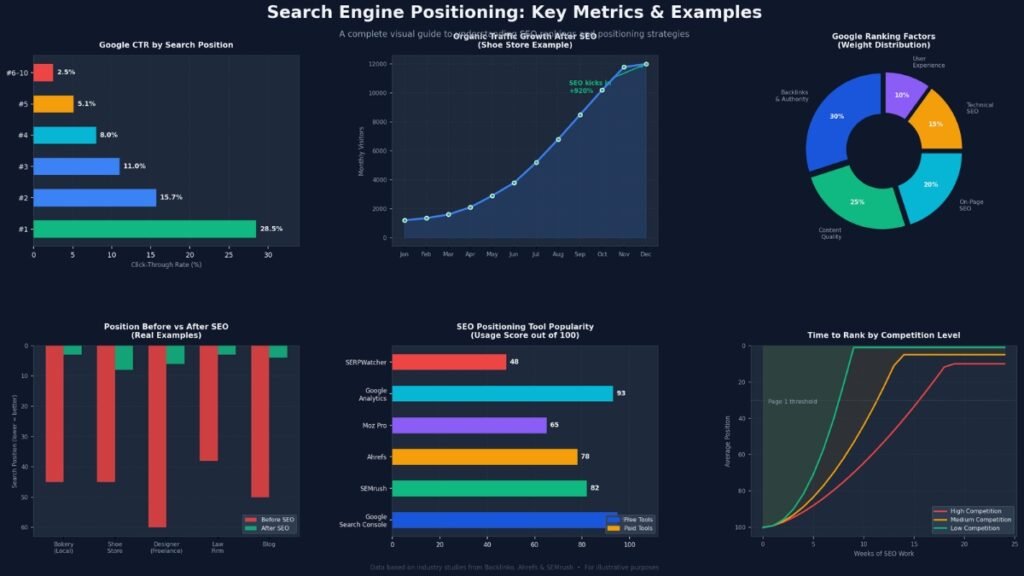
| Position in Google | Average Click Rate | What This Means |
| #1 Position | ~28% | Almost 1 in 3 people click here |
| #2 Position | ~15% | Still great, but less traffic |
| #3 Position | ~11% | Decent visibility |
| #4-#10 Position | 1-5% | Traffic drops significantly |
| Page 2 and Beyond | Less than 1% | Almost no one sees you here |
As you can see, being on page 1, especially in the top 3 spots can make a huge difference. This is why businesses spend so much time and money on improving their search engine positioning.
Real Search Engine Positioning Examples
Let us look at some real-world search engine positioning examples so you can see exactly how this works in practice.
Example 1: Local Bakery in New York
Imagine you have a bakery in New York City. You want people to find you when they search for “best cupcakes in New York.” Here is how two different bakeries might rank:
- Bakery A (Position #1): Has a fast website, uses the keyword “best cupcakes in New York” on their page, has 50 positive Google reviews, and is listed on Google Maps.
- Bakery B (Position #15): Has a slow website, does not use any specific keywords, has only 2 reviews, and is not on Google Maps.
Which bakery gets more customers from Google? Bakery A, of course. This is a perfect search engine positioning example that shows how small improvements can lead to big results.
Example 2: Online Shoe Store
An online shoe store wants to rank for “affordable running shoes.” They use these strategies:
- Write a detailed blog post about “Top 10 Affordable Running Shoes for 2026”
- Use the keyword “affordable running shoes” in the page title, headings, and content
- Get reviews from fitness bloggers who link back to their site
- Make sure their website loads in under 2 seconds
Result: Within 3 months, their page moves from position #45 to position #8. That is a search engine positioning improvement example that shows how consistent effort pays off.
Example 3: Freelance Graphic Designer
A freelance graphic designer wants to get clients online. They target the keyword “logo designer for small businesses.” Here is their search engine positioning SEO example:
- Create a portfolio page with that exact keyword in the title
- Write a blog post: “How to Choose the Right Logo Designer for Your Small Business”
- Ask past clients to leave Google reviews mentioning their design services
- Share portfolio on LinkedIn and Pinterest with links back to the website
After 6 months, the designer ranks on page 1 for their target keyword and starts getting 5-10 new client inquiries per month from Google alone.
Best Search Engine Positioning Examples by Industry
Here are some of the best search engine positioning examples across different industries:
| Industry | Target Keyword | Strategy Used | Result |
| Restaurant | “Italian food near me” | Google My Business + Local SEO | Top 3 in local pack |
| E-commerce | “buy headphones online” | Product page optimization + reviews | Page 1, position #5 |
| Law Firm | “car accident lawyer Chicago” | Long-form content + backlinks | Position #3 |
| Real Estate | “homes for sale in Austin” | Local SEO + blog content | Page 1 ranking |
| Health Blog | “how to lose weight fast” | In-depth articles + expert quotes | Featured snippet |
Search Engine Positioning Tools Examples
To improve your search engine positioning, you need the right tools. Here are some popular search engine positioning tools with examples of how to use them:
1. Google Search Console (Free)
This is a free tool from Google that shows you exactly where your website ranks for different keywords. It also tells you how many people click on your site from search results.
Example: You discover that your blog post ranks #11 for the keyword “homemade bread recipe.” With a few improvements, you can push it to page 1 and get 3x more traffic.
2. SEMrush
SEMrush is a powerful paid tool that lets you track your search engine position ranking over time. You can see your ranking history, spy on competitors, and find new keyword opportunities.
Example: SEMrush shows that your competitor ranks #1 for “handmade soap” using 5 specific blog posts. You can use this insight to create better content and outrank them.
3. Ahrefs
Ahrefs is excellent for understanding which websites link to yours (backlinks), which is a major factor in search engine positioning.
Example: Ahrefs reveals that your site has only 3 backlinks while your competitor has 150. You set a goal to build 20 new backlinks per month through guest posting and outreach.
4. Moz Pro
Moz Pro gives you a “Domain Authority” score that predicts how well your website can rank. A higher score generally means better search engine positioning potential.
5. Google Analytics (Free)
Google Analytics shows you how much traffic you are getting from search engines and which pages are performing best. It is an essential free search engine positioning example tool for beginners.
How Search Engine Positioning Works: Step-by-Step
Understanding how search engine positioning works will help you create a clear strategy. Here is a simple step-by-step breakdown:
Step 1: Keyword Research
Find out what words people type into Google when looking for your product, service, or information. Use free tools like Google Keyword Planner or paid tools like SEMrush.
- Example: If you sell dog food, you might find that “organic dog food for puppies” gets 5,000 searches per month.
Step 2: On-Page SEO Optimization
Make sure your website pages are properly set up with the right keywords in the right places. This is called on-page SEO, and it is one of the most important parts of search engine optimization positioning.
- Put your main keyword in the page title (H1 heading)
- Use related keywords in H2 and H3 subheadings
- Include your keyword naturally throughout the content
- Write a compelling meta description (the short text that appears under your link in search results)
- Use your keyword in the URL (e.g., yoursite.com/organic-dog-food-for-puppies)
Step 3: Technical SEO
This means making sure the technical parts of your website are set up correctly so Google can easily read and understand your pages.
- Make your website load in under 3 seconds
- Make it mobile-friendly (works well on phones)
- Use HTTPS (secure connection)
- Create a sitemap so Google can find all your pages
Step 4: Content Creation
Google loves websites that regularly publish helpful, high-quality content. Writing blog posts, guides, and articles around your target keywords is one of the most powerful search engine positioning improvement examples you can follow.
Pro Tip: Aim to write content that is more helpful and detailed than what is already ranking on page 1. If the top result has 800 words, try writing 1,500 words of truly useful information.
Step 5: Link Building
Getting other reputable websites to link to your site (called backlinks) is one of the strongest signals Google uses to determine search engine positioning. Think of backlinks as votes of confidence from other websites.
- Guest post on other blogs in your niche
- Create shareable infographics or research reports
- Reach out to journalists with newsworthy stories
- List your business in reputable online directories
Step 6: Track and Improve
Use tools like Google Search Console to monitor your rankings. Look at your search engine position report regularly to see what is working and what needs improvement.
Also see: How Search Engines work.
Automated Search Engine Position Tracking Example
For larger websites or agencies, manually checking rankings every day is not practical. That is where automated search engine position tracking comes in.
Here is how an automated tracking setup works:
- Connect your website to a tool like SEMrush, Ahrefs, or SERPWatcher
- Enter all the keywords you want to track
- The tool automatically checks your rankings every day or week
- You receive email alerts when your rankings change significantly
- You can export a search engine position report example in Excel or PDF format for your team or clients
Example: A digital marketing agency uses SEMrush to track 500 keywords for 20 clients automatically. Each Monday, they receive a ranking report showing gains and drops, saving them 10+ hours of manual work per week.
Search Engine Positioning for Different Website Types
For E-Commerce Websites
E-commerce sites focus on ranking their product pages and category pages. A great web search engine positioning example is Amazon — they rank for millions of product keywords because each product page is carefully optimized.
- Optimize product titles with target keywords
- Write detailed product descriptions (not just manufacturer copy)
- Encourage customer reviews — they add fresh content and build trust
- Use structured data markup so Google shows star ratings in results
For Local Businesses
Local businesses need to focus on local search engine positioning — appearing when people nearby search for their services.
- Claim and optimize your Google Business Profile
- Get listed in local directories like Yelp and Yellow Pages
- Encourage local customers to leave Google reviews
- Use keywords that include your city or neighborhood (e.g., “plumber in Houston”)
For Blogs and Content Websites
Blogs and content sites build their positioning through consistent, high-quality content creation.
- Target long-tail keywords (longer, more specific phrases with less competition)
- Build topic clusters — write multiple related articles that link to each other
- Update old content regularly to keep it fresh and relevant
Revenue Models in Search Engine Positioning Examples
Understanding revenue models in search engine positioning helps businesses see why investing in SEO is worth it. Here are the main ways businesses make money from good search engine positioning:
| Revenue Model | How SEO Helps | Example |
| E-commerce Sales | Ranking for product keywords drives buyers | Amazon, Etsy shops |
| Lead Generation | Ranking brings in contact form submissions | Law firms, dentists |
| Ad Revenue | More traffic = more ad clicks | Blogs, news sites |
| Affiliate Marketing | Product review rankings earn commissions | Tech review sites |
| SaaS Subscriptions | Content marketing drives free trial signups | Software companies |
Common Search Engine Positioning Mistakes to Avoid
Here are the most common mistakes people make when trying to improve their search engine positioning:
- Keyword Stuffing: Using your keyword too many times in an unnatural way. Google will actually penalize you for this.
- Ignoring Mobile Users: Over 60% of searches happen on mobile phones. If your site is not mobile-friendly, your ranking will suffer.
- Copying Content: Never copy content from other websites. Google wants original, unique content.
- Ignoring Page Speed: A slow website is a ranking killer. Use Google PageSpeed Insights to check and fix your load time.
- Forgetting Meta Descriptions: While not a direct ranking factor, a good meta description improves your click-through rate, which indirectly helps your positioning.
- Not Building Backlinks: Content alone is rarely enough. You need other sites to link to yours.
Search Engine Positioning on Your Resume
If you are looking for a job in digital marketing, knowing how to list search engine optimization position examples on your resume can set you apart.
Here is how to describe SEO achievements on a resume:
“Improved search engine positioning for company blog from position #45 to #7 for target keyword within 4 months, resulting in a 220% increase in organic traffic.”
“Developed and executed a search engine positioning strategy that grew monthly organic visitors from 1,500 to 12,000 over 6 months.”
“Managed automated search engine position tracking for 15 client accounts using SEMrush, producing monthly ranking reports and actionable recommendations.”
These kinds of specific, results-driven examples show employers that you understand search engine positioning and can deliver real results — which is exactly what companies want to see.
Frequently Asked Questions
What is the difference between search engine positioning and SEO?
SEO (Search Engine Optimization) is the set of actions you take to improve your website. Search engine positioning is the result, the actual spot where your website appears in search results. Think of SEO as the work and positioning as the score.
How long does it take to improve search engine positioning?
It typically takes 3 to 6 months to see significant improvements in search engine positioning for competitive keywords. Less competitive keywords can move faster — sometimes in just a few weeks.
Is search engine positioning free?
The organic (non-paid) work of improving your search engine positioning is free in the sense that you do not pay Google for rankings. However, it requires time, effort, and sometimes investment in tools or content writers. There are also free search engine positioning tools like Google Search Console and Google Analytics to get you started.
What is the best search engine positioning strategy for beginners?
Start with keyword research, optimize your existing pages, create helpful content consistently, and make sure your website is fast and mobile-friendly. These basics will produce the best results for beginners.
Final Thoughts
Search engine positioning is one of the most powerful ways to grow your business or website online. As we have seen through all the search engine positioning examples in this guide, the principles are straightforward: research your keywords, optimize your pages, create helpful content, build good backlinks, and track your results.
Whether you are a complete beginner or an experienced marketer looking to sharpen your skills, the examples and strategies in this guide give you a solid foundation to start climbing the search results.
Remember: every website that ranks on page 1 of Google started exactly where you are right now. The difference is that they took action, stayed consistent, and kept improving. Now it is your turn.
Start with one keyword, optimize one page, and track your ranking for 30 days. Small steps, taken consistently, lead to big results in search engine positioning.
Thanks for visit: search engine basics.